
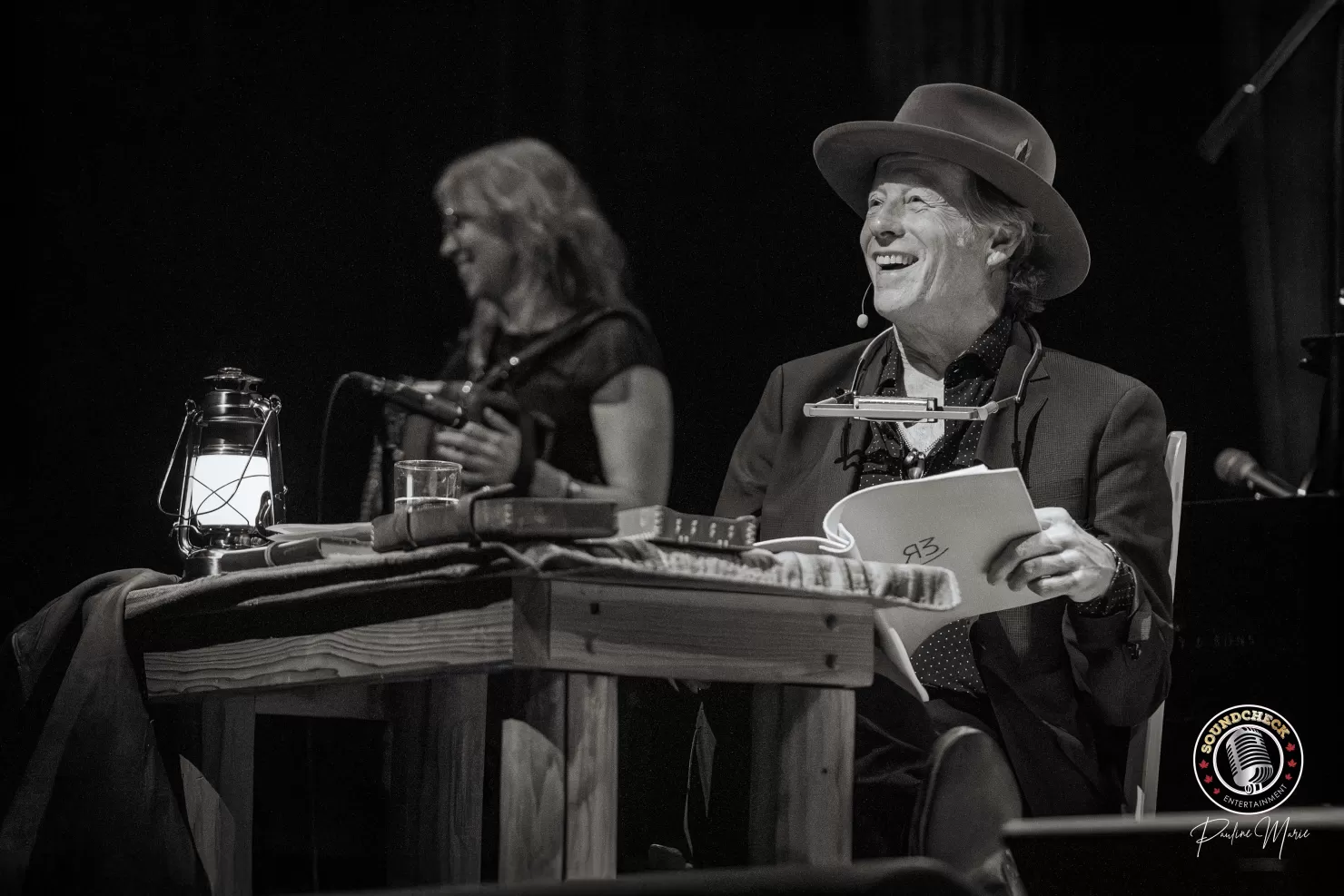
At the Mary Irwin Theatre in Kelowna, BC, Barney Bentall opened his My Life in Ranching and Rock and Roll tour to a sold-out room of 300 — an intimate setting that quickly felt even closer.
Early in the evening, he read a passage that set the tone with humor and reflection:
“What was I drawn to as a kid in high school? What was my bliss? I liked girls but was painfully shy. I liked the school band where I played trumpet but something mysterious, forbidden, thrilling, would rise within me when I would dash to get home before my sisters, head down to the basement, put Led Zeppelin II on the old RCA console, crank it up to 10 and play air guitar. I mean what did Elton John mean when he said it’s a little bit funny this feeling inside? More pertinent to my pubescent self, what was Robert Plant talking about when he said squeeze my lemon until the juice runs down? I loved the sound and the look of these bands but I also thought there was nothing cooler than the cowboy uniform. Come to think of it… I still feel that way on both fronts.”
From there, the evening unfolded as a seamless blend of storytelling and song — a living memoir shaped by music, family, and the land.
For many in the room, Bentall’s story is one that has been playing in the background of their own lives for decades. As the frontman of Barney Bentall and the Legendary Hearts, he helped define a distinctly Canadian sound — one rooted in storytelling, melody, and emotional honesty. Songs like Something to Live For and Life Could Be Worse have long outlived their era, and hearing echoes of that legacy woven into this more intimate setting gave the evening an added sense of continuity — not just where he is now, but everything that brought him here.
Videos of his Cariboo ranch and images of loved ones drifted behind him, adding a quiet, cinematic layer to the performance. It felt less like a concert and more like stepping inside a story — one told with the kind of depth only time can give.
Bentall spoke of choosing his own path despite expectations to follow the family business, a decision that echoed throughout the night. There was gratitude too — a heartfelt thank-you to his son for creating the book he read from, and another for the boots on his feet, also made by him — punctuated by a lighthearted moment as he proudly lifted one foot to show them off.
Two talented female musicians accompanied him, adding warmth and harmony without ever pulling focus from the heart of the evening.
By the end, it was clear this was more than a performance. It was a reflection — of a life shaped by ranching, music, and the courage to follow both.
At times, it felt like A River Runs Through It — quiet, cinematic, and deeply human.